Case study · 5 min read
Career Groove
Career Groove is a powerful tool for organizing your career history, skills, and application information. It allows you to create more targeted resumes by combining different pieces of information from various sources.
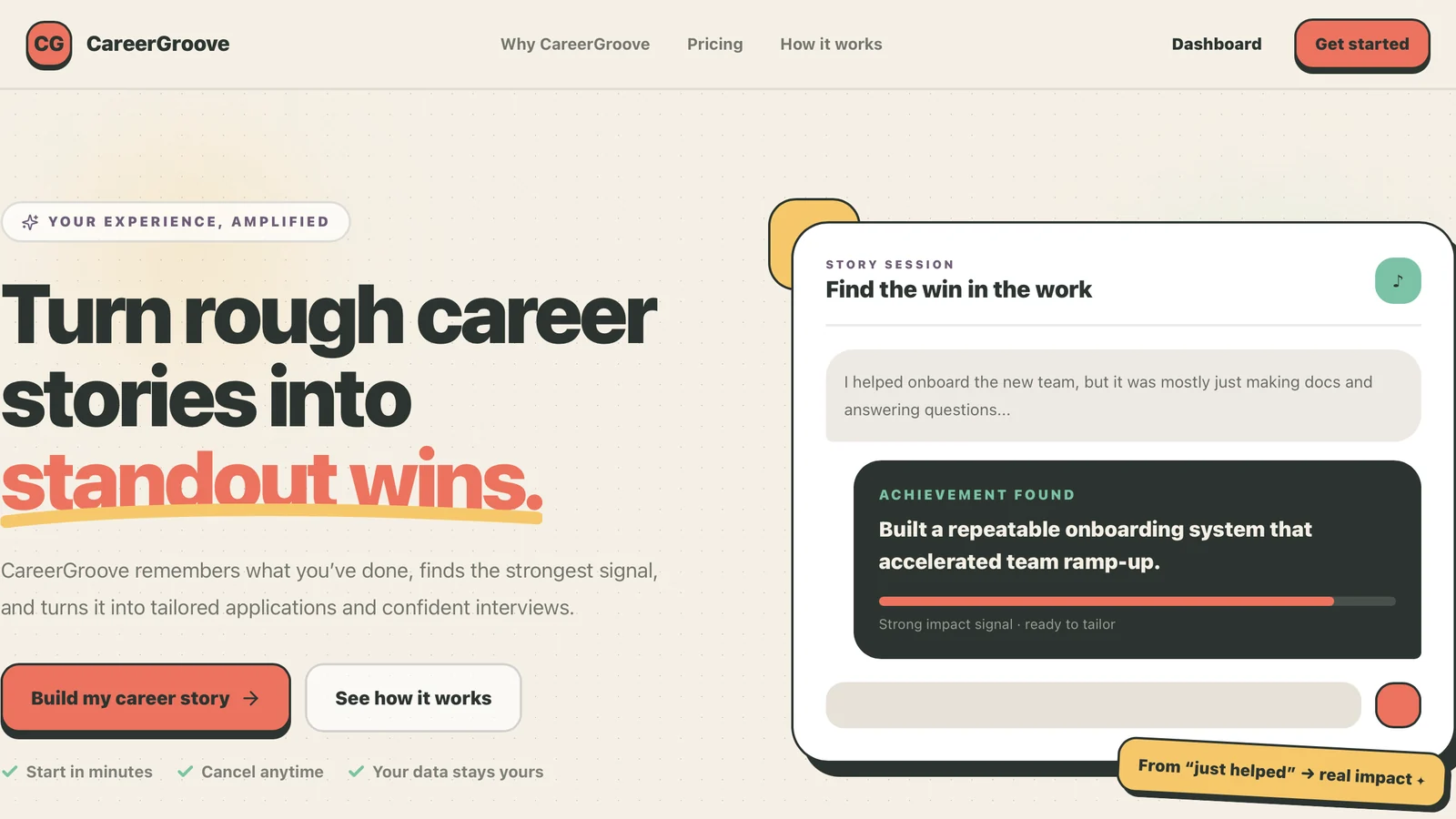
Software Case Study
A career management platform I built to turn resumes, work history, job opportunities, and application tracking into one organized system instead of a pile of browser tabs and mysteriously named resume files.
Project at a Glance
A job search needed more than another spreadsheet.
Career Groove started with a practical problem: the pieces of a serious job search were scattered everywhere. I wanted one place that understood my complete career history and could help turn that information into stronger, more targeted application materials.
| Role | Creator & Developer |
| Stack | Next.js · Node.js · SQL |
| Type | Career Web Application |
| Main Result | Improved Resume Creation |
The Problem
The job search was organized chaos.
Looking for a job sounds simple until you actually start doing it.
Find an opening. Research the company. Decide whether it is worth applying for. Adjust the resume. Write a cover letter. Answer application questions. Save the job somewhere. Remember when you applied. Follow up. Repeat.
Before long, there are seventeen browser tabs open, three slightly different resumes on the desktop, a spreadsheet that was supposed to keep everything organized, and absolutely no idea which version of the resume went to which company.
Most career tools handle one small piece of that workflow. Career Groove was my attempt to connect those pieces and treat a career as structured information instead of a collection of unrelated documents.
The idea that shaped the project
The database should know my career better than a random resume file does.
That became the foundation for how Career Groove stores experience, skills, projects, preferences, and application information.
Who Was Affected
I built it because I needed it.
The first person affected by the problem was me.
My experience spans software development, application support, databases, project management, technical customer success, and business operations. That means a single static resume is not enough.
A software development position should emphasize different experience than an implementation or application-support role.
Career Groove was designed around that reality. It can also make sense for new graduates, career changers, and job seekers whose experience does not fit neatly into one title or one resume template.
What I Built
A career system, not just a resume builder.
Career Groove stores the pieces that make up a professional history, then reuses those pieces where they make the most sense. Instead of rewriting everything for every job, I can work from a structured source of truth.
01 · Career Profile
Centralized work history, accomplishments, projects, skills, and preferences.
02 · Targeted Resumes
Build different resume directions from the same complete career record.
03 · Job Matching
Compare opportunities against actual experience and job-search preferences.
04 · Application Tracking
Keep job information, application activity, and follow-up details in one place.
05 · Reusable Career Data
Use structured information instead of repeatedly digging through old documents.
06 · Automation Ready
Give AI-assisted workflows structured data instead of asking them to guess from a giant resume.
How It Works
One source of career data powers the workflow.
The important part of Career Groove is what sits in the middle. The application does not just save finished resumes. It stores the career information used to build them, which makes the system much more flexible.
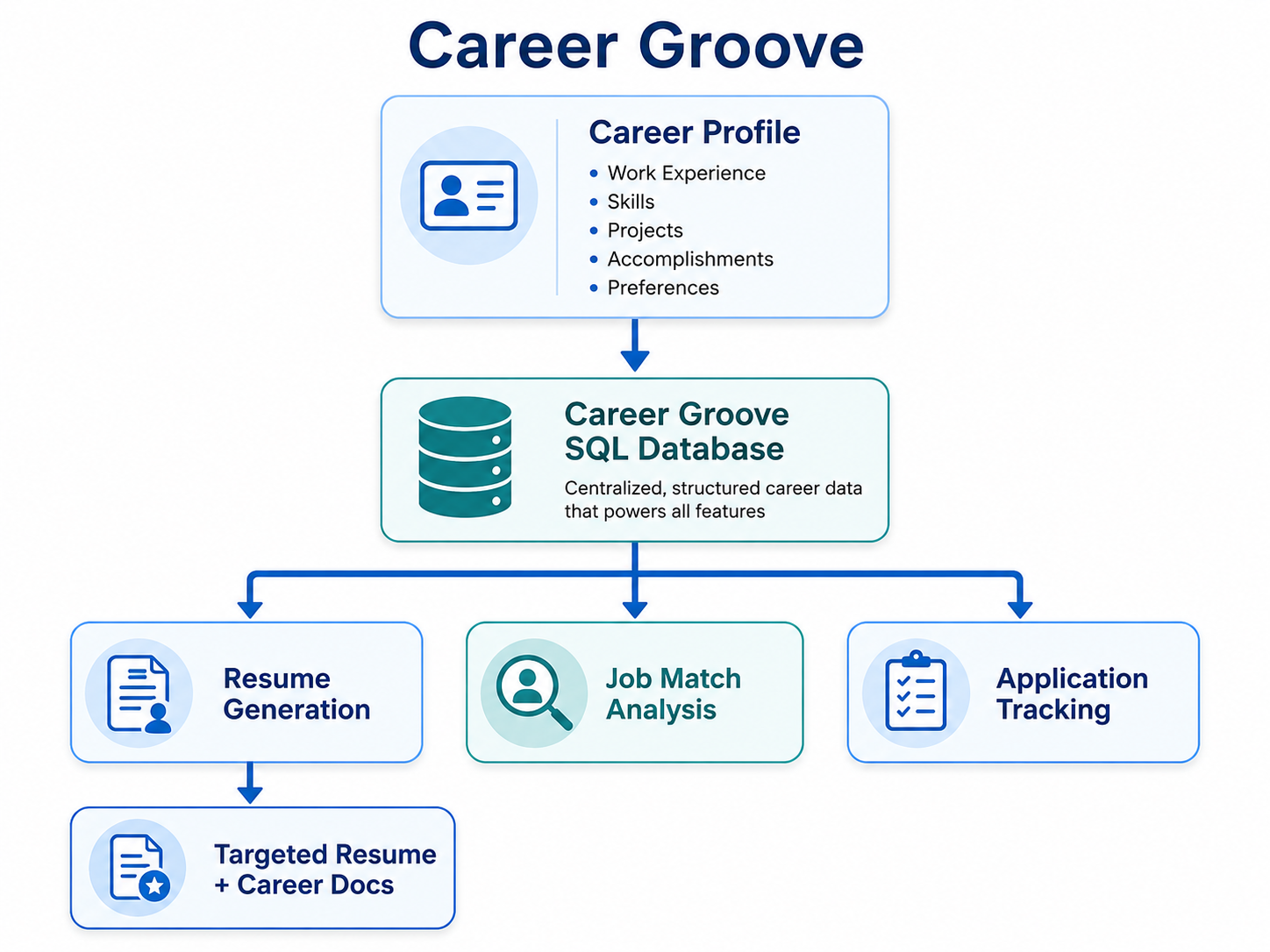
The basic flow is:
Career Profile → Career Groove SQL Database → Resume Generation / Job Match Analysis / Application Tracking
The resume-generation path then produces:
Targeted Resume + Career Documents
Technology Used
Built as a modern web application.
| Technology | How I Used It |
|---|---|
| Next.js | Provides the main application framework, interface, routing, and structure for a responsive browser-based experience. |
| Node.js | Handles the server-side application environment and supporting logic behind Career Groove's workflows. |
| SQL | Stores structured career data including work history, skills, preferences, job records, and application information. |
Career Groove was also designed with automation and AI-assisted workflows in mind.
The goal was not to have AI magically make career decisions for me. It was to give automation good structured information so it could actually be useful.
Garbage in, garbage out still applies. Apparently even robots have standards.
Obstacles
The hard part was deciding what the software should know.
A resume looks simple when it is sitting on a page.
Underneath that page, the data gets complicated very quickly.
01 · Modeling messy career information
A single job can contain accomplishments that belong on one resume but not another. Projects can demonstrate technical, communication, customer-service, and project-management skills at the same time.
The data model had to preserve all of that without becoming a digital junk drawer.
02 · Balancing automation with judgment
It is tempting to let software generate everything automatically, but career documents still need human judgment.
Career Groove needed to assist with decisions without pretending every generated answer was automatically the right one.
03 · Normalizing inconsistent job data
Job descriptions arrive in wildly different formats. Salary information may be missing, remote-work details can be vague, and apparently standardized job postings remain an optional feature of civilization.
Building reliable structures around unreliable input became an important part of the project.
Measurable Result
Resume creation became easier to manage and more consistent.
The clearest improvement from Career Groove has been the resume workflow.
Instead of rebuilding my professional history whenever I target a different type of position, I can select the most relevant information from one structured career record.
| Before | After |
|---|---|
| Rebuilding resumes from separate files | Targeted resumes from one career profile |
| Hunting through old versions for useful bullet points | Selecting relevant accomplishments from structured data |
| Reorganizing skills and sections manually | Reusing the same complete career history across multiple resume directions |
| Risking inconsistent or missing information | Maintaining one centralized source of truth |
This made resume creation faster to manage, more consistent, and much easier to maintain.
What I Learned
Good automation starts with good structure.
Career Groove taught me something I did not expect when I started the project:
The hard part of software is often not writing the code. It is deciding what the software should know.
Career information is messy. People do not fit perfectly into database tables, job titles rarely describe everything someone actually did, and the same experience can be extremely valuable for one position and almost irrelevant for another.
Designing Career Groove forced me to think about data modeling from the user's point of view instead of simply from the database's point of view.
Giving automation a giant resume and saying "figure it out" can work. Giving it structured jobs, skills, projects, preferences, accomplishments, and application history works a whole lot better.
Most importantly, Career Groove became more than a school-style programming project.
I built it because I had a real problem.
Then I started using the software to solve that problem.
Somewhere along the way, my job search went from a folder full of resumes and good intentions into an actual application.
Considering the software is supposed to help me get a job building software, that feels wonderfully circular.
Want to See Career Groove in Action?
Career Groove is the result of taking a problem I was actually dealing with and building the software I wanted to use.
Visit Career Groove →
Career Groove case study · Jeremy Guill